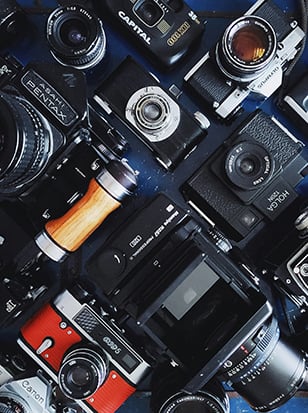
The best cameras for low light will allow to keep on shooting in dark interiors and on night-time city streets. If you're sick of attempting to capture atmospheric night shots and coming back with a blurry, grainy mess, then these are the cameras for you – powerful, capable shooters that will keep going after dark..
A good low-light camera will need a fairly sizeable sensor, a generous ISO sensitivity range, a generous lens range wih lots of large-aperture options, and more besides – you can scroll down or use the nav to jump to our 'How to choose' section for more on our criteria. We’ve split our guide up into sections for different types of camera – and there is a dedicated budget section at the end for those who have less to spend.
If you're specifically looking for a low-light camera for astro work, then you might want to check out our guides to the best cameras for astrophotography and the best lenses for astrophotography. Otherwise, read on – here are our experts' top picks of the best low-light cameras.
Best mirrorless camera for low-light photography
Modern mirrorless cameras have fantastic low-light capability, and if you’re looking for a system that will handle astro and night-time scenes, mirrorless is an excellent place to start looking. Many contemporary mirrorless cameras for pros and enthusiasts have very high megapixel counts, but if you’re shooting in low light you may want to consider something with a little less resolution, as a lower megapixel count can often mean better performance at high ISO settings.
We’ve included a mix of low-light specialist cameras and all-rounders that still do a great job in dimmer conditions. We’ve chosen cameras aimed at enthusiasts, but remember you can also scroll to the bottom of this page for more budget-friendly options. Lastly, we haven’t forgotten about video shooters, and have chosen a cracking option for low-light video in addition to mirrorless cameras more suited for stills.

Pros:
- Impressive ISO sensitivity range
- Great dynamic range, especially in RAW
- 8.5-stop stabilisation
Cons:
- May be beyond some budgets
Canon's EOS R6 Mark III is a 'do-everything' full-frame mirrorless camera designed for photographers who need something capable and flexible in all shooting situations – and as such, it's formidable in low light. It’s equipped with a powerful built-in stabilisation system that can provide up to 8.5 stops of effective compensation, allowing for much slower shutter speeds to be used handheld, allowing more light in to hit the sensor. Plus, it boasts a native ISO range that runs up to 64,000 (expandable to 102,400), and you can really push into the upper quadrants of that ISO range and still get decent images, especially if you’re willing to shoot in RAW and spend time in post-processing recovering some shadow detail.
This fast-shooting hybrid camera is an easy choice for low-light photographers, if it fits into your budget. It uses the Canon RF lens range, in which there are loads of excellent low-light options. The spectacular Canon RF 50mm f1.2L USM is a superb lens for professionals, with its ultra-wide aperture allowing it to simply drink in light. If your budget doesn't go that far, the Canon RF 50mm f1.8 STM is a great affordable option.

Pros:
- Accurate autofocus with impressive low-light sensitivity
- Broad ISO sensitivity range
- Stabilisation with 8 stops of effectiveness
Cons:
- No AF joystick
When the beautifully designed Nikon Zf made its debut, a lot of hay was made regarding its gorgeous retro looks. The all-metal design hearkens back to classic film SLRs like the Nikon FM2, with a dial-led control experience that indicates, among other things, that Nikon is looking to compete with Fujifilm in the market of gorgeous retro-styled cameras.
However, the Zf is as capable inside as it is attractive on the outside, and once you dig into the spec sheet and try out the camera for yourself, you start to see what a great low-light performer it is shaping up to be. The autofocus system is specifically optimised to operate well in low light, capable of acquiring focus in conditions equivalent to -10 EV. The in-body image stabilisation provides up to eight stops of effective compensation for hand-held shooting, and the ISO range runs from 100 to 64,000 natively.

Pros:
- Absolutely unreal high-ISO performance
- Superb phase-detection autofocus
- Dazzling high-resolution electronic viewfinder
Cons:
- Low resolution means it’s likely not suitable for pure stills photographers
While we’re focusing more on photography than video in this guide, we could hardly put together a piece on low-light cameras and not talk about the Sony A7S III. Ever since the first Sony A7S dazzled photographers and videographers alike with its ability to seemingly turn night into day, this series has become a byword for spectacular low-light performance. With an ISO ceiling of 409,600, the Sony A7S III delivers better sensitivity than ever before, resulting in images with 15+ stops of dynamic range.
As touched upon earlier, this series is more oriented towards video than stills – hence the low megapixel count of 12MP. If you are only interested in stills, this isn’t the camera for you, as you’ll get more for your money elsewhere. But if you shoot predominantly video, or are a hybrid shooter that mixes in both (and you don’t need to print too large), the A7S III is one of the finest low-light performers ever made.
Best DSLR for low-light photography
Want to shoot in low light with a DSLR? You’ll be in good company – photographers have been capturing spectacular low-light shots with DSLRs for decades now. While mirrorless may be hogging the limelight, a good DSLR can still be your imaging friend for life, and there are some amazing options to explore.
If you’re shopping for DSLRs, you’re going to be looking at options from one of the three major players in the market – Canon, Nikon and Pentax. We’ve included options from all three, focusing on full-frame cameras that are tried and tested when it comes to producing fantastic results in all conditions. And remember – one great advantage of DSLRs is the sheer number of lenses you have to choose from, especially if you’re willing to shop for second-hand lenses.

Pros:
- Glorious full-frame back side illuminated sensor
- Autofocus performs brilliantly in low light
- Delivers clean images at high ISOs
Cons:
- A relatively big and bulky camera
- Newer cameras like the Zf have improved on it
The big, beautiful Nikon D850 has earned its rightful place in the DSLR hall of fame. A speedy beast with big full-frame resolution, it’s a camera that’s renowned for just getting the shot, again and again, under any circumstances – and it certainly doesn’t falter when the light levels drop. The autofocus continues to perform brilliantly in conditions as low as -4EV, and the ISO can be pushed and pushed while still producing relatively clean images – it still does brilliantly at ISO 25,600.
The Nikon D850 is a brilliant camera, and one that many photographers are still fond of. But it’s worth mentioning that time has marched on in the six years since its release, and for features like 5-axis image stabilisation, you’re going to want a newer model. Recent cameras like the aforementioned Nikon Zf have improved on its low-light autofocus performance.

Pros:
- Pixel Shift Resolution II mode can be used hand-held
- Very broad ISO range
- Astrotracer mode for night-sky images
Cons:
- K-mount has fewer lenses than Canon EF or Nikon F
A fully featured, full-frame DSLR, the Pentax K-1 Mark II comes packing a lot of features that make it a tempting choice for low-light shooting. Its effective 5-Axis Shake Reduction system allows for the user of slower shutter speeds when shooting hand-held, and also allows specialised modes like the high-resolution Pixel Shift Resolution II (which composites multiple images together) to be used without a tripod. The ISO range is also impressive – it runs all the way to ISO 819,200, and you can definitely still get decent prints at 25,600.
If you’re an astro shooter, the Pentax K-1 Mark II is definitely worth extra consideration. Its Astrotracer functionality uses the camera’s built-in GPS and stabilisation systems to effectively create an in-camera star-tracker, allowing for long-exposure images of the night-sky without creating star trails. Using this feature, photographers have achieved exposures of multiple minutes in length and still produced sharp images of stars with no trails. Normally you need an equatorial mount to achieve something like this.
Best medium format camera for low-light photography
Digital medium format has its advantages and disadvantages in low light, which are worth considering carefully when you’re shopping for equipment. The large sensors produce fantastic dynamic range, providing tons of detail in the shadows of images. However, lenses for medium format tend to have narrower maximum apertures than full-frame, APS-C or MFT lenses, which can restrict your flexibility in low light – though this gap is narrowing, as Fujifilm, in particular, has demonstrated.
In the past, shooting digital medium format in low light would have meant you were restricted to a tripod. However, recent advancements in mirrorless medium format by the likes of Fujifilm and Hasselblad have seen great improvements in terms of autofocus and stabilisation in medium format bodies, making hand-held low-light shooting much more viable in medium format. Here are a couple of our favourite options.

Pros:
- Beautifully built body is great in all weathers
- Improved 5-axis stabilisation rated to 8 stops
- GF lens range includes f/1.7 options
Cons:
- Cheaper GFX 100S offers similar image quality
It seems like with every new entry in the GFX series, Fujifilm is redefining what medium format can do. With faster-than-ever autofocus, the GFX 100 II performs more impressively than ever with moving subjects, and its eight-stop stabilisation system provides even more latitude in low light. Image quality from the GFX 100 II’s medium format sensor is utterly sublime of course; with a dynamic range of 14+ stops it can capture a huge amount of recoverable shadow detail.
The GF lens ecosystem has also expanded to include more low-light options. Fast standard primes like the Fujifilm GF 80mm f1.7 R WR and the Fujifilm GF 55mm f1.7 R WR give the shooter more latitude in low light than ever before, while still performing optically at a high enough level to make the most of the 102MP CMOS II HS sensor.

Pros:
- Stunning high-resolution imagery
- Incredibly 15.3 stops dynamic range
- 10-stop stabilisation
Cons:
- No video option at all
The Hasselblad X2D 100C II produces sublime imagery – that’s pretty much a given for anyone who’s familiar with this spectacular medium format system. However, this newer model also packs in a number of features that make it much more viable for low light. For a start, that large sensor is capable of producing a whopping 15.3 stops of dynamic range, providing incredible latitude for rcovering detail in shadows, especially when shooting RAW. Then you've also got the class-leading in-body image stabilisation system, capable of providing up to 10 stops of effective compensation. This is better than anything else on the market, and opens up all sorts of new possibilities for long-exposure techniques without a tripod. It takes some getting used to handling a medium format camera in this way if you've never done it before, but the results are nothing short of spectacular.
Bear in mind that this is a pure stills camera through and through, without even an option to shoot video. If you want to shoot video in medium format, the GFX 100 II is the camera to buy. However, for stills purists who want an outstanding low-light camera with bags of image quality, the Hasselblad X2D 100C II is an utterly breathtaking choice.
Best budget camera for low-light photography
While we’ve featured many professional and high-end enthusiast cameras in this guide, the truth is that low-light photography doesn’t have to be expensive! There are plenty of cameras out there that will do an excellent job of shooting in low light for a much lower price than the big dogs – especially if you pair them with a solid large-aperture lens (many of which can be bought for two-figure prices).
These aren’t literally the cheapest cameras you can buy, but they are affordable models for beginners and intermediate shooters that we believe will be especially suited to low-light shooting. Remember that if you’re looking to save money it’s always worth shopping for used camera equipment, and we also have camera gear trade-in services available if you have old equipment you’re not using.

Pros:
- Very effective noise reduction
- Live View Boost makes composition easier in low light
- Lots of lightweight, affordable lenses available
Cons:
- AF can struggle in low light
- No stabilisation
'Low light' and 'budget' aren't concepts that easily mix – it tends to be the Achilles' heel of most affordable cameras. However, the Nikon Z50 II, Nikon's entry-level mirrorless model, is a solid bet and is our recommendation. Equipped with an APS-C sensor, it's capable of delivering significantly better dynamic range than a smartphone, improving shadow detail, and its flexible RAW files allow for further recovery of detail.
For those who prefer to shot JPEG, Nikon's in-camera noise processing punches above its weight, making the higher ISO settings on the Z50 II like ISO 12,800 and even ISO 25,600 useable – the camera does have higher and extended settings, but they are probably best saved for emergencies only.
As far as lenses go, the Nikon Z system offers a range of large-aperture optics that are great for low light and shouldn't blow your budget; our recommendations are TTArtisan 50mm f2, the Viltrox AF 56mm f1.7 and the Nikon Z 24mm f1.7 DX, the latter of which is specifically designed for DX-format (APS-C) cameras like the Z50 II.
How to choose
Low-light shooting has its own unique requirements when it comes to gear, so there are a few key features to hone in on when picking your camera. These are the key specs we’ve kept in mind when making our picks for this guide:
High ISO performance - The higher you can push the ISO setting on a camera, the more shooting flexibility you’ll have in low light. However, a camera needs to do more than just offer high ISOs – it needs to actually produce usable images at those settings.
In-body image stabilisation. Low-light photography is all about gathering as much light as possible. Image stabilisation systems help with this as they allow you to use longer shutter speeds while still getting acceptably sharp images. Bear in mind that this only factors in when you’re shooting hand-held – if the camera is mounted on a tripod, stabilisation isn’t a factor.
Sensor size/type - Larger sensors such as APS-C and full-frame are often desirable for low-light as they tend to perform better at high ISO settings. Some cameras also have back side illuminated (BSI) sensors, which provide better light sensitivity and noise control.
Lens options - All the cameras we’ve featured in this guide are interchangeable-lens models, and choice of lens is hugely important when it comes to low-light shooting. The wider the aperture you can get on your lens, the more flexibility you’ll have when it comes to shooting in low-light.
FAQs
How can I improve my low-light photography skills?
You can enhance your low-light photography by using a tripod to stabilise your camera, adjust your camera settings, such as ISO, aperture, and shutter speed, and finally use a wide-aperture lens for better light intake.
What is ISO in low-light photography?
ISO in low-light photography represents the sensitivity of your camera's sensor to light. A higher ISO setting allows your camera to capture more light in low light conditions but can introduce noise. Balancing ISO with other settings is crucial for achieving the best results.
How can I reduce noise in low-light photos?
The best way to reduce noise in low light your photos is to use the lowest ISO setting possible while maintaining proper exposure, but you can also use noise reduction software in post-processing. Additionally, you can shoot in RAW format for more control over noise reduction during editing.
What is the best lens for low-light photography?
A prime lens with a wide aperture, such as an f1.4 or f1.8, is ideal for low-light photography. These lenses allow more light to enter the camera, resulting in better performance in dark conditions.
How do I use long exposure in low-light photography?
Long exposures involve keeping the camera's shutter open for an extended period, often seconds or minutes. This technique captures more light, making it suitable for low light situations. To use a long exposure, use a tripod and set a slow shutter speed.
What is light painting in low-light photography?
Light painting is a creative technique in low-light photography where you use a light source (e.g., flashlight or LED) to "paint" light onto a subject while the camera is in long exposure mode. This creates artistic and unique effects.
Can smartphone cameras capture good low-light photos?
Some smartphones have advanced low-light photography capabilities, but they may not match the performance of dedicated DSLR or mirrorless cameras. Look for smartphones with larger sensors and Night Mode features for better results in low light.
How do we decide?
Our in-house photography specialists, store staff, and industry partners work together to review our buying guides and advice articles. We also monitor emerging trends and listen closely to customer feedback, ensuring our recommendations stay current and relevant to what photographers and filmmakers are actually looking for.
By carefully curating the products we recommend, our guides are designed to offer clear, trustworthy advice that helps customers choose the right kit with confidence.
If you would like further advice, our contact centre team are here to help. You can also reach us via email or social media. And remember, if you purchase based on our recommendations, your order is covered by our full returns policy.


Sign up for our newsletter today!
- Subscribe for exclusive discounts and special offers
- Receive our monthly content roundups
- Get the latest news and know-how from our experts