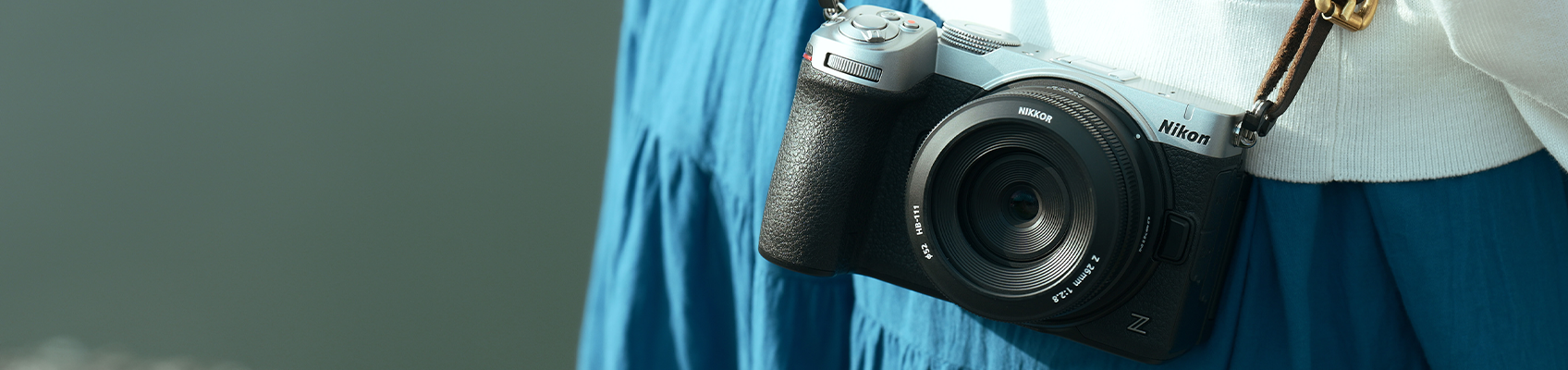
There’s never been a better time to buy an entry-level full-frame mirrorless camera, and now Nikon users have even more choice. With the release of the Nikon Z5 IIC, joining its stablemate, the Z5 II, Nikon now offers two distinct takes on the entry-level full-frame experience.
Both cameras share the same 24.5MP BSI full-frame sensor, along with the EXPEED 7 processor and a whopping 7.5-stop IBIS (In-Body Image Stabilisation), yet they aim to deliver different shooting experiences. If you’re trying to decide which one deserves that coveted place in your camera bag, here are the five main differences you need to know about…
-
Electronic viewfinder (EVF) vs. Screen-centric design
It should come as no surprise that our first point of difference is also the most obvious. Visually, the biggest difference between the two models can be found - or not found - on top of the camera body.
The Nikon Z5 II offers a high-resolution 3.69M-dot Electronic Viewfinder (EVF), so you have a choice of how you line up your images (EVF or LCD), as is standard with most mirrorless cameras. However, the Z5 IIC completely removes the Electronic Viewfinder and its associated bump, leaving the top plate flat and giving the camera a more rangefinder-style body.
With no EVF, the only way you can compose images is by using the LCD. This is less of a problem when capturing video footage, but those who primarily shoot stills may not want to work without an EVF.
-
Rear display resolution
It’s a tale of two halves when it comes to the LCD, which, as we’ve explained, is the only way to compose when using the newer Z5 IIC.
On the positive front, both cameras feature a large 3.2-inch display with a fully articulating, touch-sensitive design, enabling the user to tilt the LCD for awkward high- or low-angle compositions, as well as flip it around when presenting to camera.
However, there is a difference in LCD resolution between the two cameras. While the Z5 II offers a 2.1M-dot LCD panel, the more affordable Z5 IIC makes use of a lower-resolution 1.04M-dot LCD.
-
Dual vs. Single card slots
Another difference between the two cameras is the storage configuration. The Z5 II offers users two UHS-II SD card slots, while the Z5 IIC offers only one.
There are multiple benefits to having a second card slot. Firstly, it allows users to record to both cards at the same time, creating an instant backup of their content in case anything happens to one of the cards. Secondly, a second card slot can bring some order to your workflow, as users can choose to record stills to one card and video files to the other, ensuring that the two media types remain separate.
That said, not every photographer will need to create a backup, so one SD card may well be enough for you.
-
Button layout
While both cameras share many features, there are some differences between the button layouts of the Z5 II and Z5 IIC. One of the most important contrasts is the AF joystick. This is a popular feature on the Z5 II, enabling users to adjust their focus point quickly.
Its pronounced form factor is especially useful if the user is wearing gloves, as it allows for firm and controlled operation. The AF joystick is missing from the Z5 IIC, which is a shame, as the majority of photographers will deem it a very useful feature.
However, the more affordable Z5 IIC strikes back by offering a dedicated tally light that illuminates red when the camera is recording video footage. This will be of particular interest to vloggers, who will appreciate the more video-focused functions on offer for creating content.
What’s more, the Z5 IIC is also the first Nikon full-frame mirrorless camera to offer Scene modes, which simplify the process of choosing the right settings for different subjects and situations.
-
Weight saving
Our last big difference relates to the weight of the cameras - an important factor if you plan to carry your camera around all day.
As you’d expect, the removal of the EVF and second SD card slot, along with other exclusions, means that the Z5 IIC is the lighter camera, tipping the scales at 620g. Following behind - but not by that much - is the Z5 II, which weighs 700g, making for a difference of 80g.
With the EVF removed, the Z5 IIC measures 134 x 80.5 x 72mm - a little shorter in height than the Z5 II, which measures 134 x 101 x 72mm.
That said, both cameras are compact and sit at the lightweight end of the spectrum for full-frame mirrorless cameras.
About the Author
Matty Graham is a photographer, writer and presenter who creates editorial features that inform and inspire photographers across a wide range of creative disciplines. Through articles, videos and events, he shares practical advice, product insights and real-world techniques to help photographers get more from their kit. Take look at his website and follow his Instagram.
Trending Buying Guides





Sign up for our newsletter today!
- Subscribe for exclusive discounts and special offers
- Receive our monthly content roundups
- Get the latest news and know-how from our experts